 Photoshop
 Maya
Maya ZBrush
 Houdini
 Substance Painter
 Blender
 Unreal Engine
 Arnold
 Nuke
Nuke KeyShot
 V-Ray
V-Ray Marmoset Toolbag
 Mari
Mari Marvelous Designer
 Substance Designer
 3ds Max
 3DCoat
 Redshift
 Faceform Wrap
 Lightroom
 After Effects
 OctaneRender
 SpeedTree
 Daz 3D
 Agisoft Metashape
 Fusion
 Modo
Modo RealityCapture
 Gaea
Gaea Cinema 4D
 Gravity Sketch
 Premiere
 Procreate
 Clip Studio Paint
 SketchUp
 SketchBook
 Katana
 Natron
 Mudbox
 Quixel Bridge
 Quixel Megascans
 Quixel Mixer
 Substance 3D Modeler
 World Creator
 Yeti
Yeti Ziva VFX
 Mixamo
 Adobe Medium
 Quixel DDO
 xNormal
 Meshmixer
 Storyboard Pro
 DaVinci Resolve
 TreeIt
 World Machine
 Gaffer
 Corel Painter
 SynthEyes
 Krita
Krita Massive
 Materialize
 Unity
Unity Ornatrix
 PreForm
 Moi 3D
 animBot
 QuickTime
 ReCap
ReCap
















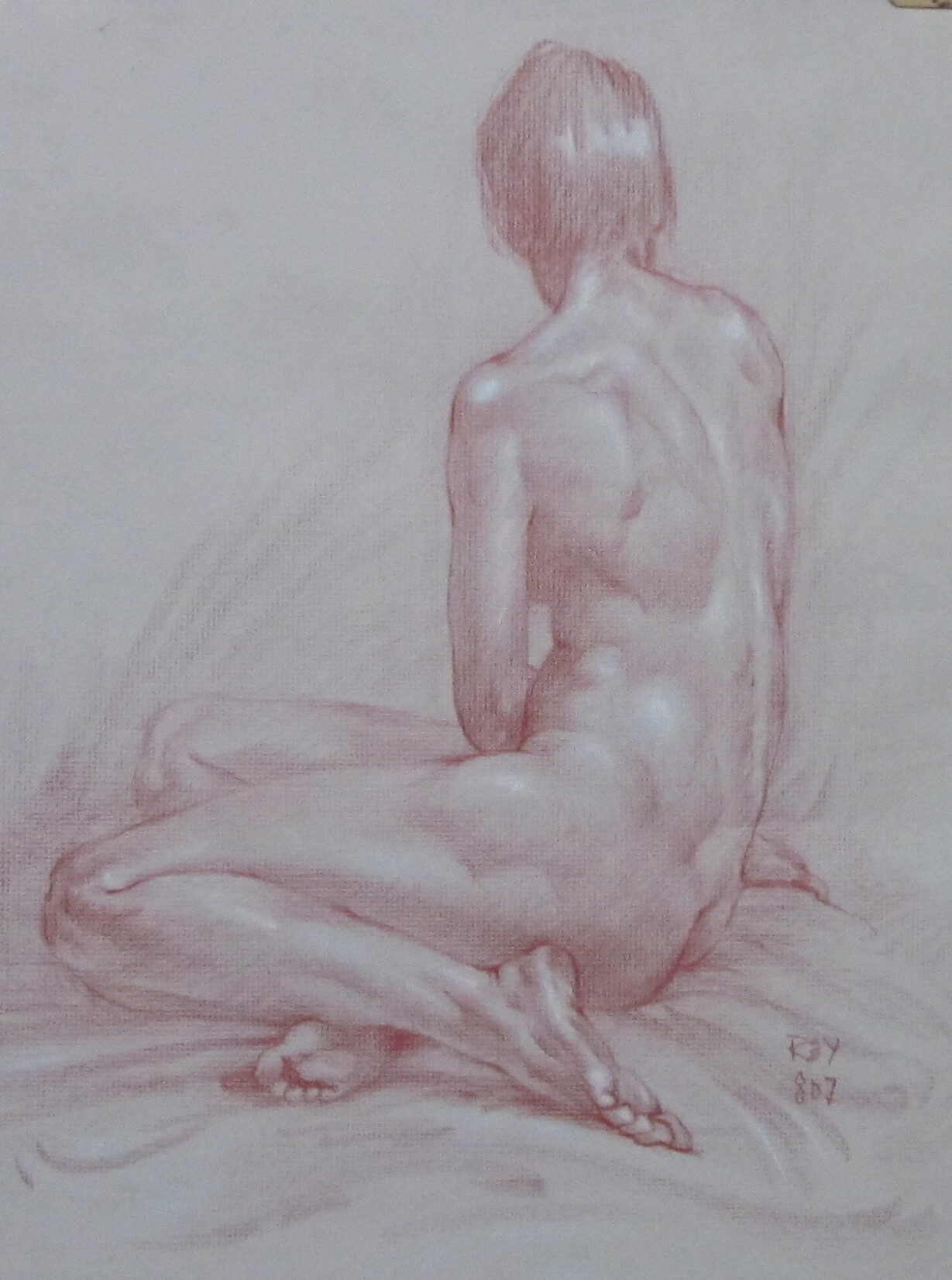
“Artistic Anatomy” refers to the essential muscles that create the visible shapes that we see on a model’s physique. Rey Bustos, famed illustrator and anatomist, teaches how to illustrate the complex back and shoulder muscles in a way that is preferred by most artistic anatomists.
When illustrating, it’s not necessary for artists to know every single muscle of the body. By editing the key number of muscles that artists need to know down to a minimum, Rey begins the workshop with a focus on the Sacrospinalis (or Erector) spinae group — some of the deep muscles in the center of the back that can be found along the spine all the way up to the base of the skull. These complicated, often-stringy muscles are important and keep humans upright — but they can be challenging for artists to study individually. Rey reveals the simplest way to understand and interpret this muscle group and teaches easy-to-remember strategies for illustrating the forms.
Moving on, Rey addresses the medial form in the lower back, in between the two posterior superior iliac spines, and works up to the thorax. Thereafter, he layers muscles by placing them in order onto the skeletal frame to complete the study of the back and shoulders. His lectures in this 1-hour, 20-minute workshop are accompanied by stories that will help with remembering the shapes and relationships of the muscles and anatomy — and are essential to making things memorable and easy to digest. A traditional drawing demonstration concludes the workshop to put all the theory into practice.
4 Lessons
This introduction sets the stage for an anatomy workshop by Rey Bustos that aims to demystify the complex musculature of the back and shoulder region. Rey demonstrates a commitment to making the material accessible, offering a beginner's approach to understanding challenging anatomical structures. Artists explore these foundations to build a better understanding of the human form.
Duration: 16s

This lesson provides a practical, artist-focused approach to understanding back anatomy by emphasizing visible landmarks and simplified structures. Artists learn to recognize what is visible on a live model without needing to memorize every medical term. Rey emphasizes that understanding the underlying skeletal framework and key landmarks allows for an accurate representation of the figure even when structures are not fully visible.
Duration: 14m 57s

In this lesson, Rey emphasizes that artists do not need to master anatomy to the level of medical professionals, though understanding basic muscle layering and variation is essential. By using memorable visual metaphors and systematically building knowledge, Rey demonstrates that anatomical knowledge enhances creativity. Artists explore how understanding what lies beneath the skin allows for a more accurate and expressive representation of the human form.
Duration: 49m 26s

Anatomical knowledge, while initially challenging, ultimately liberates artists to create dynamic, expressive work. Rey teaches that mastery requires patience and consistent practice, as the initial awkward phase is temporary and worthwhile. By understanding underlying anatomical structure while maintaining loose drawing techniques, artists learn to achieve a poetic interpretation of the human form, transforming technical knowledge into artistic expression.
Duration: 35m 17s

Project Files
After downloading the workshop files, you'll receive access to Rey Bustos's reference files. Inside, you'll find:
- Reference materials (.jpg) – Reference images and texture files to support your workflow
Skills Covered
Who’s this Workshop for?
This workshop is built for intermediate to advanced artists who want to master anatomical illustration, particularly those working in fine art, concept art, medical illustration, or academic study. Artists with basic figure drawing experience who struggle with complex back and shoulder anatomy will find Rey Bustos’s simplified approach the most valuable.
Beginner-level artists who are ready to tackle anatomy seriously will also benefit significantly from this focused instruction. The workshop's storytelling approach and memory techniques make complex muscular relationships accessible, while the traditional drawing demonstration provides practical application that bridges theory with hands-on practice for lasting skill development.
Learning Outcomes
Once artists have completed the workshop, they will have developed essential skills for accurately illustrating the complex back and shoulder anatomy using simplified, memorable techniques.
Key skills include:
- How to identify and illustrate the key muscles that create visible shapes in back anatomy.
- How to simplify the complex sacrospinalis muscle group into understandable, drawable forms for artistic purposes.
- How to understand the medial form relationships between the lower back and thorax regions.
- How to layer muscles systematically onto the skeletal frame for accurate anatomical construction.
- How to apply memory techniques and visual storytelling to retain complex muscular anatomy knowledge.
- How to translate anatomical theory into practical drawing application through traditional demonstration methods.